
Why Most Life Sciences Websites Don’t Convert and What to Fix First

Key Takeaways
Clear messaging drives conversion
Outcome focused pages perform better than capability lists
Visible proof builds trust faster
Strong CTA paths increase qualified inquiries
Answer oriented content supports AI search and SEO
In life sciences, credibility is rarely the real problem.
Many companies already have deep expertise, strong leadership, meaningful traction, and a real track record of delivering value. They may support clinical programs, enable research, build specialized platforms, or help customers solve highly technical problems.
And yet, their websites still fail to convert.
Traffic comes in. Visitors browse. A few pages get viewed. Then they leave.
Not because the company is not qualified. Not because the offer is weak. But because the site never fully translates credibility into buyer confidence, or buyer confidence into action.
That gap matters more than ever. Buyers in biotech, pharma, healthcare, and related life sciences sectors are busy, skeptical, and under pressure. They do not want to work hard to figure out what a company does, who it helps, why it is different, or what to do next. If those answers are not obvious quickly, they move on.
A website should not just look professional. It should help the right visitor understand the offer fast, trust it, and take the next step. That is the difference between a digital brochure and a true growth asset.
The Real Reason Most Life Sciences Websites Under-perform
Most under-performing websites do not fail because of design alone.
They fail because the commercial story is too hard to decode.
A visitor lands on the homepage and sees language that sounds polished, but vague. The messaging may be technical, mission driven, or aspirational, but it does not answer the buyer’s first questions:
What exactly does this company do?
Who is it for?
What outcome does it deliver?
Why should I trust them?
What should I do next?
When those pieces are missing, the site may still look credible, but it will not perform like a lead engine.
What to Fix First
1. Clarify the Value Proposition Above the Fold
Many life sciences websites lead with messaging that sounds impressive but does not clearly communicate the offer.
A buyer should not need to interpret the headline. Within seconds, they should understand what the company provides, who it serves, and why it matters. That does not mean oversimplifying complex work. It means translating expertise into a message the market can process quickly.
A stronger homepage opening usually makes four things clear:
What you do
Who you help
What problem you solve
What the visitor should do next
If the offer is not clear immediately, the site creates friction before trust ever has a chance to build.
2. Replace Generic CTAs With a Guided Conversion Path
“Contact us” is not a strategy. Neither is “Get in touch.”
For a specialized life sciences buyer, a generic CTA often feels premature or disconnected from the evaluation process. Visitors need a path that feels relevant to their stage, intent, and problem. That path may include a consultation offer, service specific pages, resource driven entry points, or landing pages aligned to demand generation activity. The point is not just to place a button on the page. It is to guide a qualified visitor toward action.
3. Stop Describing Capabilities as Tasks and Start Selling Outcomes
This is one of the most common issues on life sciences websites. Companies describe their services accurately, but not persuasively. They list capabilities, tasks, and functions. But buyers are not only looking for a list of what you do. They are looking for what changes because of what you do.
Do you help them move faster? Reduce complexity? Improve reliability? Support scale up? De risk a program? Strengthen commercialization? Accelerate decision making?
Those are the outcomes buyers care about. That shift alone can make a website feel far more commercial, persuasive, and conversion ready.
4. Put Proof Where Decisions Happen
Many life sciences companies already have strong proof. They have client logos, testimonials, case studies, scientific credentials, leadership credibility, or examples of meaningful outcomes.
But too often, that proof is buried.
Proof should not be isolated on one page or tucked away in a footer. It should appear where the buyer needs confidence the most, near the value proposition, inside service pages, next to calls to action, and throughout the content journey.
Trust signals are most effective when they are part of the buying journey, not separate from it.
5. Build for Discovery and Decision Making
A modern life sciences website has to do more than rank. It has to answer.
Buyers increasingly use AI assisted search, direct answer tools, and more exploratory discovery behavior before they ever fill out a form. That means websites need content that is structured, specific, and easy for both humans and machines to interpret.
That includes service pages with clear entities and use cases, FAQ modules, internal linking, case study content, structured proof, and expertise rich resources.
A website that supports both discovery and conversion becomes much more valuable than one that functions only as an online brochure.
What a High Converting Life Sciences Website Actually Does
A better website is not simply more polished. It performs a commercial job.
It helps the right buyer understand the offer quickly. It translates expertise into a clear market facing narrative.It uses proof to reduce hesitation. It creates a path to action. It supports visibility in search and AI assisted discovery. And it acts as an extension of the sales process.
That is how a website becomes the bridge between credibility and pipeline.
Final Thought
If your life sciences website is not converting, the answer usually is not to drive more traffic. The first answer is to make the existing experience do more work.
Clarify the offer.
Strengthen the path to action.
Shift from capabilities to outcomes.
Make proof visible.
Structure the site for both discovery and conversion.
Because the companies that win are not always the loudest. They are often the ones whose digital presence makes expertise easy to trust, and easy to act on.
Frequently Asked Questions
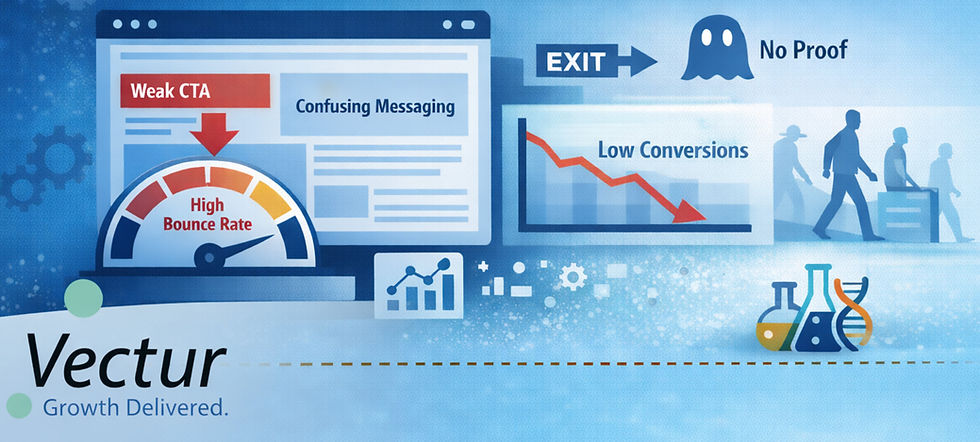
Why do life sciences websites struggle to convert? Most life sciences websites fail to convert because the value proposition is unclear, the CTA path is weak, proof is buried, and service pages describe capabilities instead of business outcomes.
What is life sciences website conversion? Life sciences website conversion refers to turning qualified website visitors into meaningful actions, such as consultation requests, form fills, demo requests, or other sales conversations.
Does FAQ content help with AI search? Yes. FAQ content can help AI systems better understand what your page answers, especially when it is paired with clear headings, structured data, internal linking, and strong on page relevance.
What should a high converting life sciences website include? A high converting life sciences website should include clear messaging, outcome focused service pages, visible proof, strong calls to action, and content designed for both search discovery and buyer decision making.
What should I fix first on a life sciences website? Start with the homepage value proposition, CTA structure, trust signals, and service page messaging. Those changes usually have the biggest impact first.


Comments